Child Car Seats in Taxis



Child Car Seats in Taxis: What UK Law Actually Says
A UK taxi or minicab does not have to provide a child car seat. Licensed taxis and private hire vehicles hold a legal exemption. A child under 3 may travel in the rear without a seat. A child aged 3 or over may use an adult belt. Where a suitable seat is available, it must be used.
Fastlane Transfers
Written and reviewed by our operations team. Fastlane Transfers is a licensed private hire operator holding operator licences with seven UK councils, including Greater Manchester, London and Surrey. Companies House no. 13231404.
The Rules by Age
The rules change depending on your child's age and on whether a seat is fitted in the vehicle. The table below covers licensed taxis and private hire vehicles in the UK.
| Your child | The rule in a licensed taxi or minicab |
|---|---|
| Under 3, no seat fitted | Rear seat only. Your child may travel without a seat belt. |
| Under 3, seat fitted | The seat must be used. It must meet R44 or R129 approval. |
| Under 3, front seat | Only in an approved child seat. Never on an adult belt alone. |
| Aged 3 to 11, or under 135cm, no seat fitted | An adult seat belt in the rear seat. |
| Aged 3 to 11, or under 135cm, seat fitted | The seat or booster must be used. |
| Aged 12 or over, or 135cm and taller | An adult seat belt, the same as any passenger. |
R44 and R129 are the two approval standards for child seats sold in the UK. R129, sometimes called i-Size, is the newer of the two. Any seat fitted by a licensed operator should carry one of these markings on the shell.
Two points are worth reading twice. A child under 3 may legally travel with no restraint at all, but only in the rear. And a fitted seat is never optional, whatever your child’s age.
Why Taxis and Minicabs Are Treated Differently
The exemption is practical. It is not a judgement that travelling without a seat is safe.
It is written for journeys nobody plans. You leave a hospital late at night. Your car will not start. A pushchair will not fit alongside the luggage. Refusing those journeys would leave families stranded, and being stranded carries its own risk. The law makes room for that.
The rule covers both kinds of licensed vehicle. Hackney carriages, the black cabs you hail or take from a rank, are exempt. Private hire vehicles, also called minicabs, are exempt on identical terms. Several guides online state that black cabs are exempt while minicabs must comply. That is not correct, and it is the most common error published on this subject.
What matters is the vehicle's licensed status. Not its shape, its colour, or how you booked it.
One thing the exemption does not change is the physics. A small child held by an adult belt is less well protected than a child in a seat sized for them. Road safety bodies are consistent on this. The law permits the journey. It does not recommend it.
That gap between permitted and advisable matters most on longer trips. An airport run is not a short hop across town.
When a Seat Is Provided, It Must Be Used
The exemption carries a condition. Almost nobody writes about it.
The exemption applies when a suitable child seat is not available in the vehicle. Once a suitable seat is fitted, it must be used. That holds for any child under 12 years old or under 135cm tall, whichever comes first.
So a fitted seat is not an optional extra you can decline at the kerb. Request one when you book, and it becomes the thing your child travels in.
Two thresholds, and they do not match
| The rule | The threshold |
|---|---|
| A child must use a suitable seat | Under 12, or under 135cm |
| The driver is responsible for restraint | Under 14 |
That second row surprises people. Where the rules are broken, the driver is the one penalised. The fixed penalty is £100, rising to £500 if the case reaches court.
What this means for a pre-booked transfer
Add your child's age at the time of booking. The correct seat is then selected and fitted before the car reaches you. There is nothing to assemble on the pavement and nothing to carry through a terminal.
Fastlane fits child and booster seats free of charge on every transfer.
Earley and Lower Earley (RG6)
Includes Thames Valley Park, home to major technology employers. Pickup from any of the business park buildings, plus residential Earley and Lower Earley postcodes.
Green Park and southern Reading (RG2)
Green Park business park is one of Reading's most-requested corporate pickup points, along with the residential streets of Whitley, Shinfield, and southern Reading.
Wokingham, Bracknell, and the wider RG area
Fastlane Transfers also picks up from Wokingham (RG40, RG41), Bracknell (RG12, RG42), and the surrounding villages across the RG postcode area. Same fixed-fare model, quote confirmed at booking.
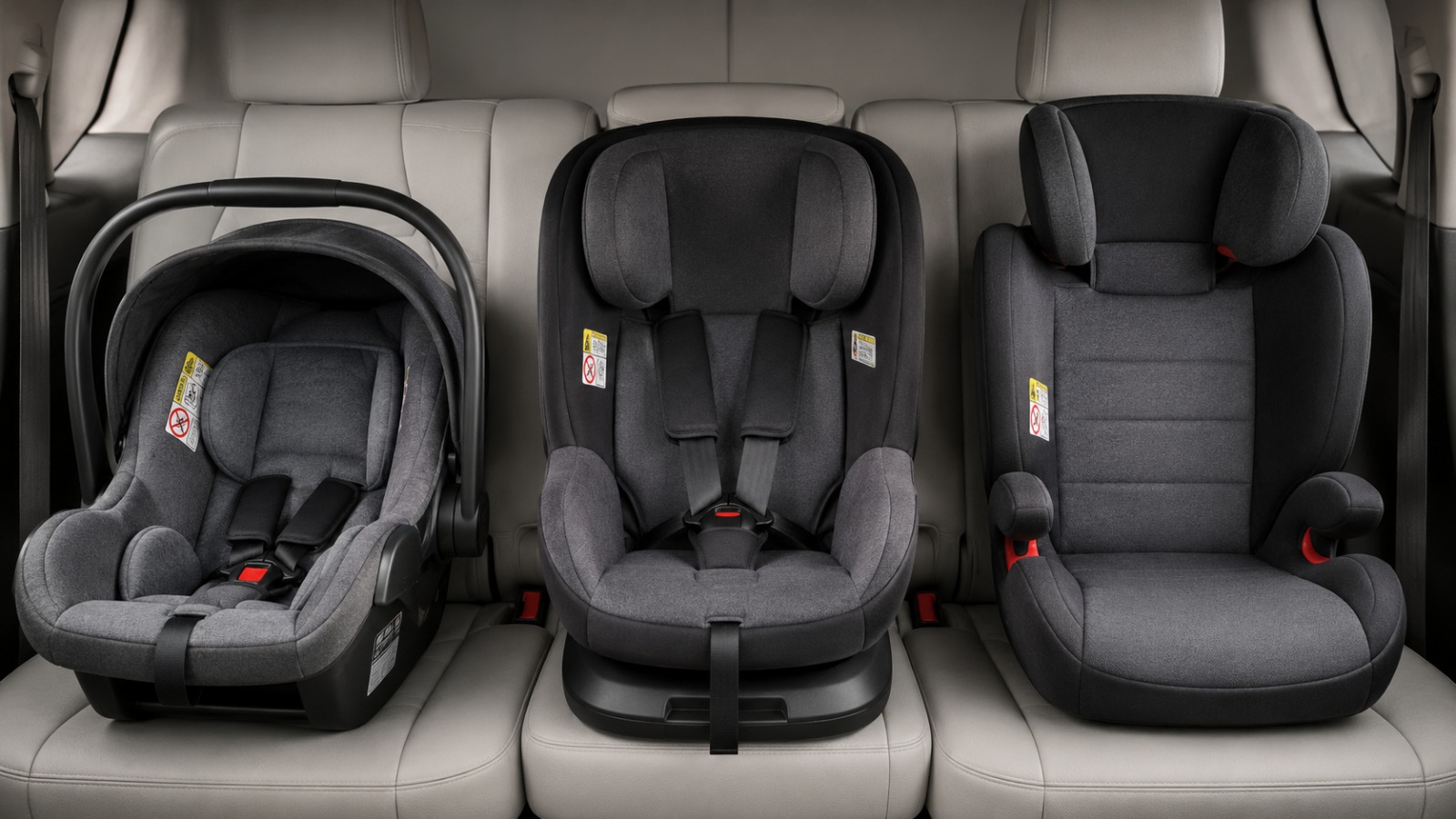
Travelling with a Baby or Toddler in a Taxi
The under-3 case is where most parents hesitate. The law permits the journey. Whether you take it is a separate decision, and it usually comes down to what seat you can get.
Which seat suits which age
| Seat type | Suits |
|---|---|
| Rear-facing infant carrier | Newborn to around 15 months |
| Forward-facing seat with harness | Around 15 months to 4 years |
| High-back booster | Around 4 to 12 years, or up to 135cm |
Height-based seats, marked R129 or i-Size, must stay rear-facing until your child passes 15 months. Weight-based seats carry the older R44 marking. Either is legal.
One recent change catches people out. New booster cushions are only approved for group 3, which starts at 22kg. Cushions you already own remain legal to use, but a high-back booster gives better side protection.
Bringing your own seat
You are welcome to. It needs to be compatible with the vehicle and fitted correctly, so tell the operator in advance rather than arriving with it unannounced.
The catch is everything either side of the journey. A car seat is bulky, it is one more thing to carry through a terminal, and it goes nowhere useful once you land. Most parents travelling by air would rather not.
Requesting a seat instead
Add your child's age when you book. The right seat is chosen and fitted before the car arrives.
Taxis, Minicabs and Uber Compared
The law treats every licensed vehicle the same way. What changes is whether you can arrange a seat before the car turns up.
| Option | Can a seat be fitted in advance? |
|---|---|
| Black cab from a rank | No. You take the vehicle that arrives. |
| Ride-hailing app | Rarely. Uber advises UK riders to bring their own. |
| Pre-booked private hire | Yes. The seat is specified when you book. |
Uber is direct about this in its own UK rider guidance. It tells riders that child seats are uncommon in app vehicles, and that assuming you need to bring one is the safer approach. Drivers may also decline a trip if they are not comfortable fitting a seat you have brought.
Uber's guidance also notes that a driver may decline the trip if they are not comfortable with a seat being fitted in their car. That is a reasonable position for them, and an unhelpful one if you are due at a terminal.
A black cab sits under exactly the same legal exemption. The difference is timing. You cannot request a seat from a vehicle you have not booked.
Pre-booking is the only route that lets you give your child's age ahead of the journey.
Airport Transfers and Long Journeys
An airport transfer booked as a taxi or private hire journey follows the same rules. The exemption applies exactly as it does on a two-mile trip across town.
The practical picture is different though. The exemption was written with short, unplanned journeys in mind. A motorway run of forty minutes or more is neither.
The arrivals problem
Think about what landing actually looks like. You clear passport control after a long flight. Your child is tired and probably past caring. You have suitcases, possibly a pushchair, and a phone with no signal until you find the wifi.
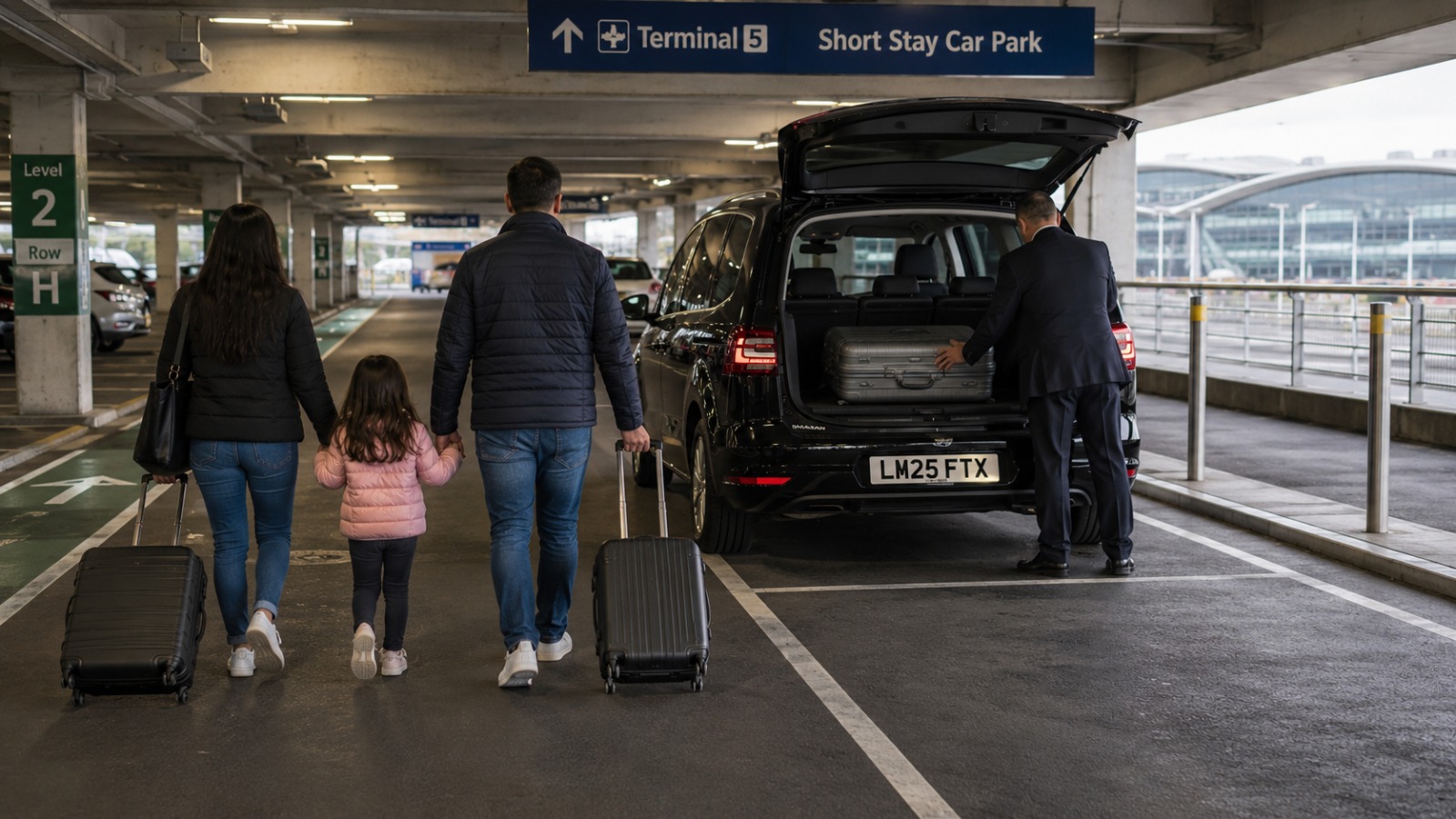
Assembling a car seat at that moment is nobody’s idea of a good start.
Heathrow does not permit waiting at the kerb, so arrivals pickups happen from the short-stay car park. That means a short walk to the vehicle with everything you are carrying. A seat already fitted removes one job from a list that is long enough.
Departures are easier, but the seat still has to come from somewhere
Heading out, you can carry your own seat. It then has to be checked in, collected at the far end, and brought home again. Many families would rather it stayed at home.
On a Fastlane transfer
Add your child's age at booking. The right seat is fitted before the driver sets off, at no charge, on the way out and on the way back.
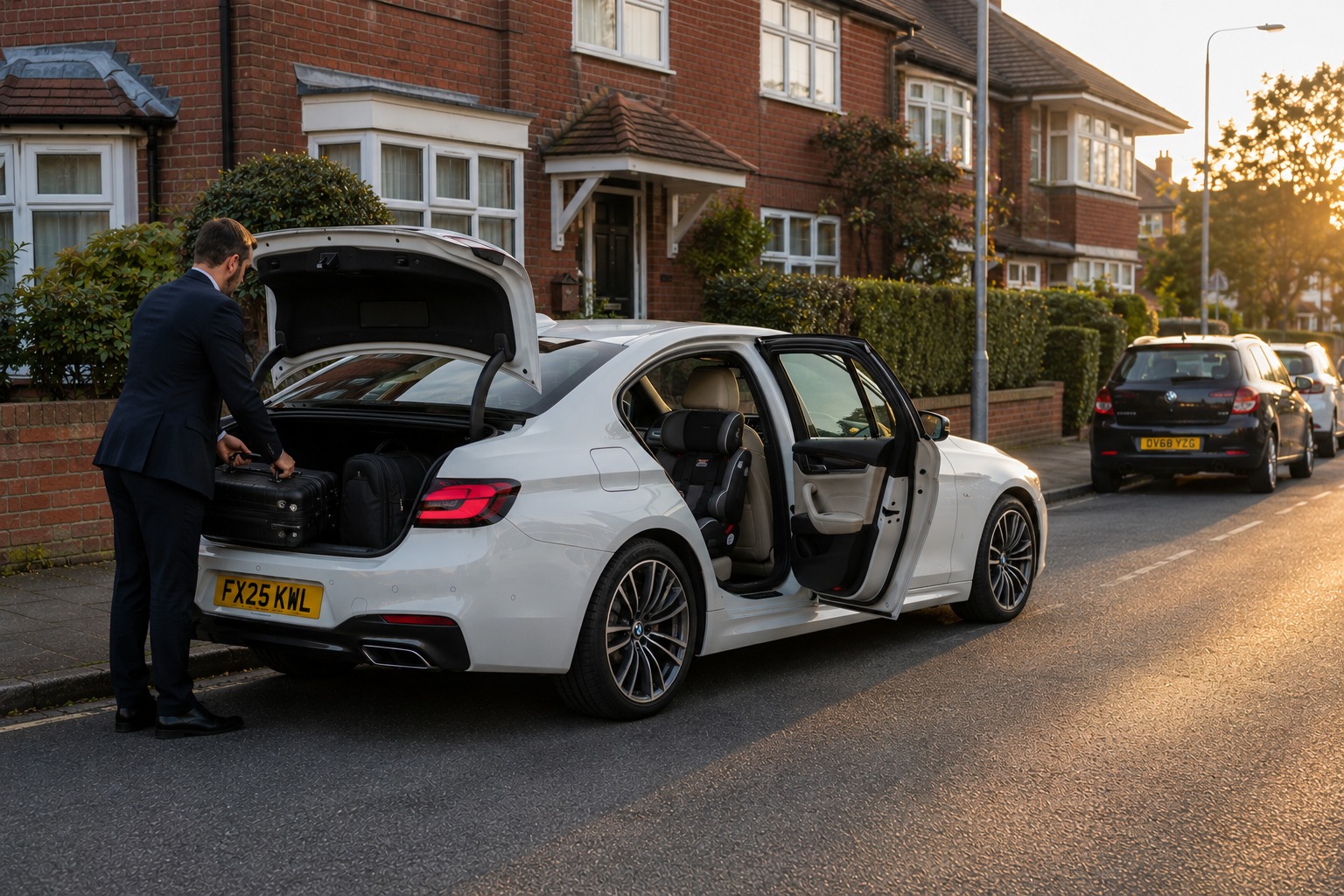
How to Book a Taxi with a Seat Already Fitted
Three things make the difference between a seat that is ready and a seat that is a conversation at the kerb.
Give your child's age when you book, not on the day. Age determines which of the three seat types goes in, and that choice is made before the driver sets off.
Book ahead rather than hailing. A vehicle you have not booked cannot carry a seat chosen for your child.
Say if you are bringing your own. It needs to be compatible with the vehicle, so the operator should know in advance.
Fastlane fits child and booster seats free on every transfer, in both directions. Add the age at booking and the seat is in the car when it arrives.
For the Heathrow-specific version, including terminal pickup detail, see our guide to booking a Heathrow taxi with a child seat fitted.
Frequently Asked Questions
1. Do you need a car seat in a taxi in the UK?
No. Licensed taxis and private hire vehicles are exempt from the child car seat requirement. A child under 3 may travel in the rear without a seat. A child aged 3 or over may use an adult belt. Where a seat is fitted, it must be used.
2. Can a baby travel in a taxi without a car seat?
Yes, in the rear seat only, and without a seat belt. This is legal but it is not the safest option. On a longer journey, a fitted seat is worth arranging in advance.
3. Do black cabs and minicabs follow the same rules?
Yes. The exemption covers licensed hackney carriages and private hire vehicles on identical terms. Guidance claiming that minicabs must comply while black cabs are exempt is incorrect.
4. Does Uber provide car seats in London?
Not as standard. Uber's own UK guidance tells riders that seats are uncommon in app vehicles and advises bringing one. A Car Seat option exists in some cities with a surcharge and one seat per vehicle.
5. Can my child sit in the front of a taxi?
A child under 3 may sit in the front only in an approved child seat. Under the taxi exemption, children travelling without a seat must use the rear.
6. What if the taxi has a seat but I would rather not use it?
The seat must be used. The exemption applies only when a suitable seat is not available, so fitting one removes the choice for any child under 12 or under 135cm.
7. Do the same rules apply to airport transfers?
Yes. An airport transfer booked as a taxi or private hire journey sits under the same exemption. The journey is longer, which is why most families prefer a seat fitted in advance.
8. Should I bring my own car seat to the airport?
You can, and it is legal, provided it fits the vehicle and is correctly fitted. Most families would rather not check a seat in and collect it again. Requesting one instead avoids that.
9. Who is responsible if the rules are broken?
That second row surprises people. Where the rules are broken, the driver is the one penalised. The fixed penalty is £100, rising to £500 if the case reaches court.
Sources
Sources: GOV.UK, Child car seats: the rules. Child Car Seats (childcarseats.org.uk), supported by RoSPA. Uber UK rider guidance.
This page explains the law in plain terms. It is not legal advice.
Travelling with a Child?
Fastlane fits child and booster seats free of charge, chosen by age and fitted before your driver arrives. Fixed fares, all airport charges included.